
Blog · Clinical guide
How to Calculate Creatinine Clearance
The Cockcroft-Gault formula, a full worked example, the 24-hour urine method, and how to handle children, obesity, pregnancy and carboplatin dosing — explained step by step.
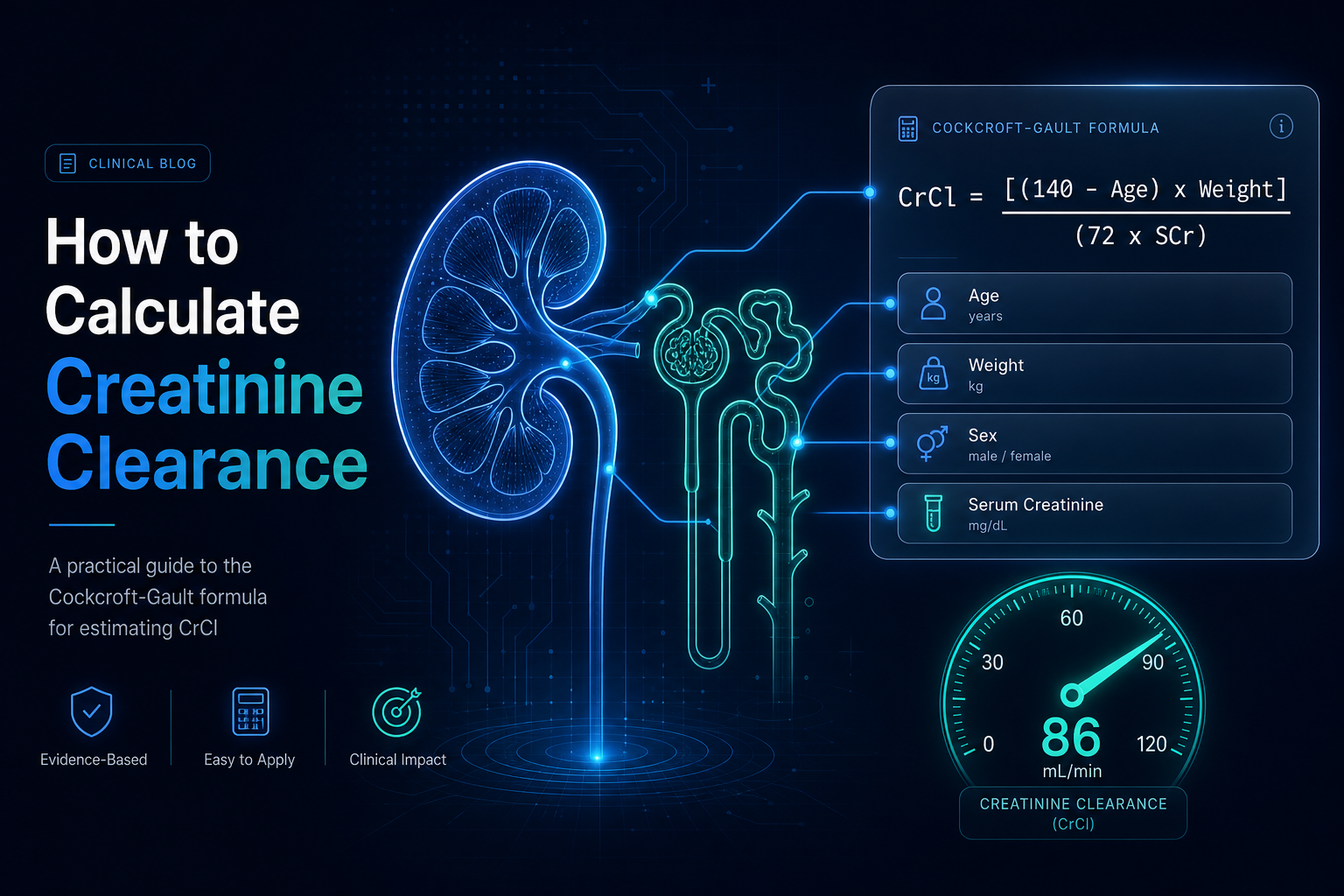
Quick answer
To calculate creatinine clearance, use the Cockcroft-Gault formula: CrCl (mL/min) = [(140 − age) × weight in kg] ÷ (72 × serum creatinine in mg/dL), then multiply by 0.85 for female patients. Prefer our creatinine clearance calculator for the automatic weight-basis logic, unit conversion and CKD-stage interpretation described below.
What is creatinine clearance?
Creatinine clearance (CrCl) is the volume of blood plasma the kidneys clear of creatinine each minute, reported in mL/min. Because creatinine production from muscle is fairly constant and the kidneys filter (and slightly secrete) it efficiently, calculated creatinine clearance is used every day as a practical, bedside estimate of glomerular filtration rate (GFR) — and, more importantly for clinicians, as the exact unit that most renal drug-dosing thresholds are written in.
A commonly cited creatinine clearance normal range is roughly 97–137 mL/min in adult men and 88–128 mL/min in adult women, declining gradually with age. See our full breakdown on the creatinine clearance calculator home page, including CKD-stage bands and dosing context.
The creatinine clearance formula (Cockcroft-Gault equation)
The creatinine clearance formula almost every textbook, drug label and Cockcroft-Gault calculator uses is:
CrCl (mL/min) = [(140 − age in years) × weight in kg] ÷ (72 × serum
creatinine in mg/dL), multiplied by 0.85 if the patient is female.
SI form (creatinine in µmol/L): CrCl = [(140 − age) × weight in kg × 1.23
(male) or 1.04 (female)] ÷ serum creatinine in µmol/L.
This is the same creatinine clearance equation published by Cockcroft and Gault in 1976. It was derived from patients with stable renal function and was never intended to be BSA-normalised, which is why Cockcroft-Gault CrCl (mL/min) and CKD-EPI eGFR (mL/min/1.73 m²) are related but not identical numbers, even though both aim to describe kidney function. See our eGFR calculator to compare both values for the same patient side by side.
How to calculate creatinine clearance: step by step
-
Collect four inputs. Age (years), biological sex, body weight, and a recent, stable serum creatinine in mg/dL or µmol/L.
-
Normalise the units. Convert pounds to kilograms (÷ 2.2046). If creatinine is in µmol/L, divide by 88.4 to reach mg/dL.
-
Choose the weight basis. Actual, ideal, or adjusted body weight — see the table below. This single decision causes almost every disagreement between two people who both claim to calculate creatinine clearance correctly.
-
Apply the Cockcroft-Gault equation.
(140 − age) × weight ÷ (72 × SCr), then ×0.85 for female patients. -
Interpret the number. Compare the mL/min result against the normal range, a CKD stage band, and any drug-label dosing threshold relevant to the patient's medications.
Worked example: creatinine clearance calculation
Here is a full creatinine clearance example using actual body weight, worked by hand:
| Step | Calculation | Result |
|---|---|---|
| 140 − age | 140 − 62 | 78 |
| Numerator | 78 × 78 kg | 6,084 |
| Denominator | 72 × 1.1 mg/dL | 79.2 |
| CrCl (male) | 6,084 ÷ 79.2 | 76.8 mL/min |
For a female patient with identical numbers, multiply by 0.85: 76.8 × 0.85 = 65.3 mL/min. That single correction factor is the entire difference between how to calculate creatinine clearance for male versus for female patients in Cockcroft-Gault — everything else in the equation is identical.
Prefer not to do the arithmetic by hand? Run the same numbers through our free creatinine clearance calculator, which also compares the result against CKD-EPI 2021 and MDRD automatically.
How to calculate creatinine clearance with adjusted body weight
Cockcroft-Gault is sensitive to which body weight you plug in. Use this table to decide, then see the diagram beneath it:
| Body habitus | ABW ÷ IBW ratio | Weight to use | Why |
|---|---|---|---|
| At or below ideal weight | < 1.0 | Actual body weight | No excess fat mass to correct for |
| Normal to overweight | 1.0 – 1.3 | Ideal body weight | Tracks lean mass, which produces creatinine |
| Obese (BMI ≥ 30) | > 1.3 | Adjusted body weight = IBW + 0.4 × (ABW − IBW) | Actual weight alone overestimates clearance |
| Very low muscle mass | any | Actual weight, interpret cautiously | Low creatinine production can falsely inflate CrCl |
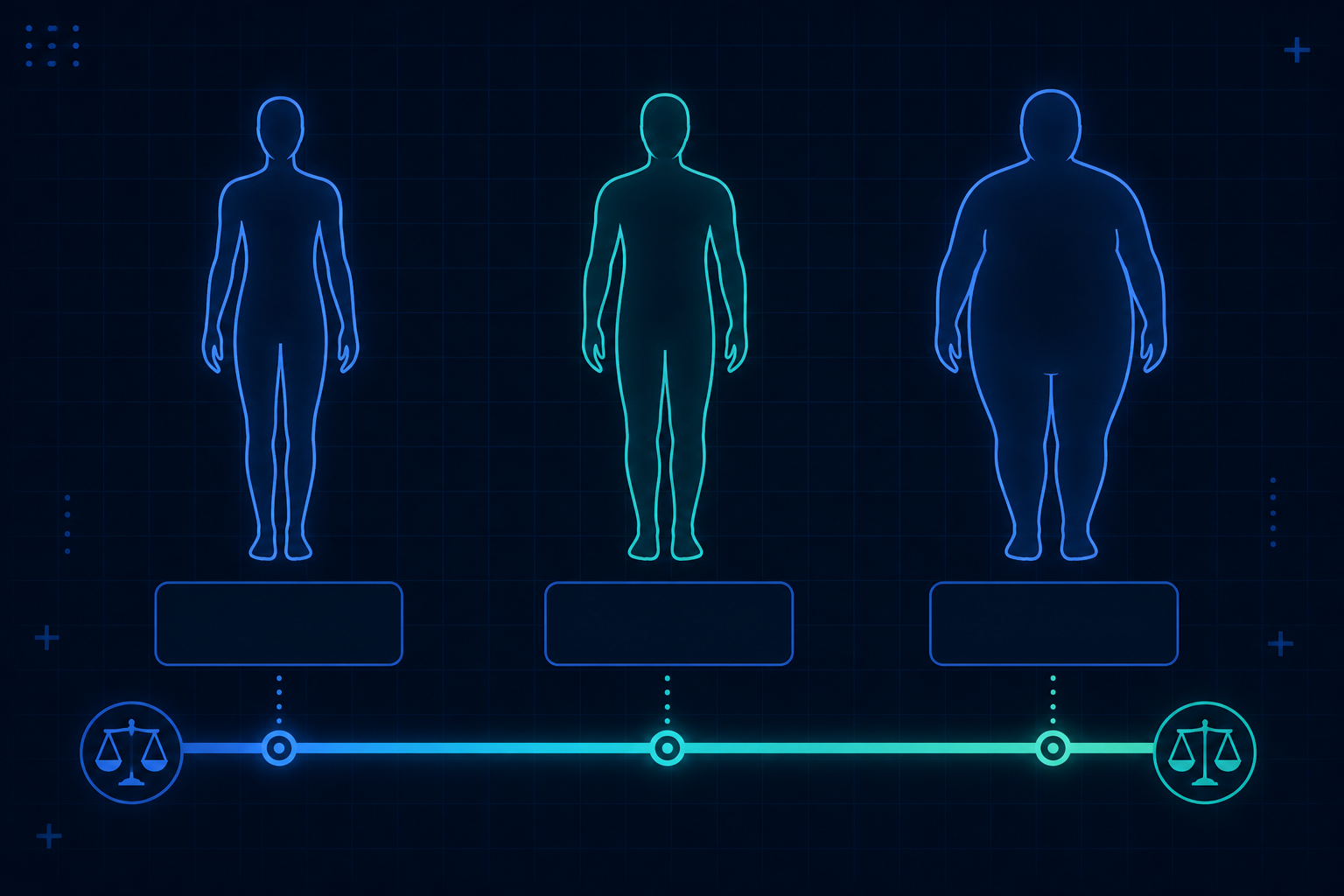
This is also how to calculate creatinine clearance with body surface area comparisons in mind: Cockcroft-Gault itself is not BSA-normalised, but you can compare its mL/min output against a BSA-normalised eGFR on our eGFR calculator, which shows both values side by side.
How to calculate creatinine clearance from a 24-hour urine collection
When body habitus, amputation, or very low muscle mass make formula estimates unreliable, clinicians fall back on the directly measured method — how to calculate creatinine clearance using a 24-hour urine collection instead of an equation:
Measured CrCl = (Urine creatinine × Urine volume) ÷ (Plasma creatinine × Collection time in minutes) — commonly simplified to (Urine Cr × 24-hour urine volume in mL) ÷ (Plasma Cr × 1,440 minutes).
This method answers how to calculate creatinine clearance from urine creatinine and how to calculate creatinine clearance from 24 hour urine directly, without relying on an age/sex/weight formula at all. Its accuracy depends entirely on a truly complete collection — a missed void anywhere in the 24 hours meaningfully skews the result.
| Feature | Cockcroft-Gault formula | 24-hour urine collection |
|---|---|---|
| Speed | Instant (one lab value) | 24+ hours |
| Inputs needed | Age, sex, weight, serum creatinine | Timed urine + plasma creatinine |
| Best for | Routine drug dosing, day-to-day trending | Atypical body habitus, amputation, borderline dosing decisions |
| Main error source | Wrong weight basis, unstable creatinine | Incomplete collection |
How to calculate creatinine clearance from GFR or eGFR
A frequent question is how to calculate creatinine clearance from GFR or how to calculate creatinine clearance from eGFR, or the reverse — how to estimate creatinine clearance from GFR or calculate GFR based on creatinine clearance. The honest answer: there is no reliable direct conversion formula, because the two numbers are built differently.
- Cockcroft-Gault CrCl is reported in mL/min, uses actual/ideal/adjusted weight, and is not indexed to body surface area.
- CKD-EPI eGFR is reported in mL/min/1.73 m², does not use weight, and is indexed to a standard 1.73 m² body surface area.
In practice, clinicians calculate each one directly from the same lab values using its own equation on our creatinine clearance calculator and eGFR calculator, then compare the two mL/min-vs-mL/min/1.73 m² numbers side by side rather than converting one into the other.
Special populations
Several searches ask how to calculate creatinine clearance in pediatrics, in children, in neonates, in obese patients, and in pregnancy. Cockcroft-Gault was derived in non-pregnant adults, so each of these groups needs a different approach:
| Population | Recommended approach | Notes |
|---|---|---|
| Children & pediatrics | Bedside Schwartz formula: eGFR = k × height (cm) ÷ SCr (mg/dL) | k varies by age; not the Cockcroft-Gault equation |
| Neonates | Neonatal/age-specific nomograms per unit protocol | Maternal creatinine still clears at birth; needs specialist input |
| Obese adults | Cockcroft-Gault with adjusted body weight | See weight-basis table above |
| Pregnancy | 24-hour urine collection preferred | GFR rises ~40–65% in pregnancy; formulas are not validated |
How to calculate carboplatin dose with creatinine clearance
Oncology teams also ask how to calculate carboplatin dose with creatinine clearance. Carboplatin is one of the few chemotherapy agents dosed by target exposure rather than body surface area, using the Calvert formula:
Carboplatin dose (mg) = Target AUC × (GFR + 25). Many protocols substitute a calculated creatinine clearance for GFR, historically capped at 125 mL/min as in the original Calvert methodology.
This is a high-stakes oncology calculation. It must be confirmed against your institution's current protocol, pharmacy verification, and the manufacturer's product labelling — never dosed from a generic web formula alone. This article explains the concept; it is not a substitute for an oncology pharmacist's dose verification.
FAQ: how to calculate creatinine clearance
What is the formula to calculate creatinine clearance?
The Cockcroft-Gault equation: CrCl (mL/min) = [(140 − age) × weight in kg] ÷ (72 × serum creatinine in mg/dL), ×0.85 for female patients.
How do you calculate creatinine clearance by hand, step by step?
Subtract age from 140, multiply by weight in kg, divide by 72×serum creatinine (mg/dL), then ×0.85 for women. See the full worked example above.
How do you calculate creatinine clearance from a 24-hour urine collection?
Measured CrCl = (urine creatinine × urine volume) ÷ (plasma creatinine × collection time in minutes) — a directly measured value, not a formula estimate.
How do you calculate creatinine clearance from GFR or eGFR?
There is no reliable direct conversion. Calculate each from labs using its own equation (Cockcroft-Gault for CrCl, CKD-EPI for eGFR) and compare them side by side instead.
How do you calculate creatinine clearance in children and neonates?
Use the bedside Schwartz formula (eGFR = k × height ÷ serum creatinine), not Cockcroft-Gault, which is adults-only.
How do you calculate creatinine clearance in obese patients?
Use adjusted body weight: IBW + 0.4 × (actual weight − IBW), instead of actual body weight, when BMI is 30 kg/m² or higher.
How do you calculate creatinine clearance in pregnancy?
Cockcroft-Gault is not validated in pregnancy. A 24-hour urine creatinine clearance is generally preferred when accuracy matters.
How do you calculate carboplatin dose using creatinine clearance?
Calvert formula: Dose (mg) = Target AUC × (GFR + 25), often substituting a calculated CrCl capped at 125 mL/min. Always confirm against your institution's oncology protocol.
Can you calculate creatinine clearance without knowing body weight?
Not with Cockcroft-Gault. If weight is unavailable, a race-free CKD-EPI eGFR (no weight required) is often used instead, keeping in mind it is BSA-indexed, not an absolute mL/min value.
What is a normal creatinine clearance range?
Roughly 97–137 mL/min in adult men and 88–128 mL/min in adult women, declining gradually with age.
Why does my creatinine clearance differ from MDCalc or another online calculator?
Usually settings, not math: the weight basis used, whether a low creatinine was rounded up, and whether the result was BSA-normalised. Match those and every Cockcroft-Gault calculator agrees.
What is the calcium-to-creatinine clearance ratio?
A distinct calculation comparing urine calcium and creatinine clearances, used to help distinguish familial hypocalciuric hypercalcemia from primary hyperparathyroidism — not the same as estimating kidney function alone.
Medically Reviewed By